Is Your Law Firm Ready to Offer Employment-Based Immigration Services?


Your firm is ready to offer employment-based immigration services when four things are true: you have the technical capacity to handle the casework, a client acquisition process built for employer clients, pricing that protects your margin across multi-stage matters, and systems that can track deadlines over timelines measured in years, not weeks. Most firms considering this move have one or two of those pieces. Very few have all four — and the gap between “interested” and “ready” is where new practice lines quietly lose money.
The good news: readiness is buildable. This article walks through each of the four areas as a practical self-assessment, so you can see exactly where your firm stands before you take your first PERM case.
Why is employment-based immigration attractive for law firms right now?
Employment-based immigration is attractive because it pairs recurring, business-client revenue with work that is process-driven and therefore scalable. Unlike many consumer practice areas, your client is often an employer — a company that may sponsor multiple employees over multiple years. One well-served HR director can become a pipeline of PERM, H-1B, and L-1 matters rather than a single engagement.
The work is also unusually systematizable. A PERM labor certification follows a defined sequence: prevailing wage determination, recruitment, filing, and — if selected — audit response. An I-140 petition and adjustment of status follow it. Because the steps repeat from case to case, a firm with strong workflows can delegate much of the production work to trained paralegals while attorneys focus on strategy, review, and client counsel. That’s the economic engine of a profitable employment-based practice.
But that same structure is why unprepared firms struggle. Process-driven work rewards firms with processes. If your current practice runs on memory and heroics, employment-based immigration will expose that immediately.
Do you have the technical capacity to handle employment-based cases?
Technical capacity means someone in your firm — attorney or experienced paralegal — has genuinely worked these case types before, not just read about them. Employment-based immigration is unforgiving of on-the-job learning at the client’s expense. A missed recruitment step in a PERM case can restart a months-long process. A weak response to a Request for Evidence can sink an otherwise approvable I-140.
Ask yourself honestly:
- Has anyone on your team personally prepared a PERM case from prevailing wage through filing?
- Could your firm respond confidently to a PERM audit or an RFE on an EB-2 or EB-3 petition?
- Do you understand how priority dates and visa bulletin movement affect the advice you give an employer today?
If the answer is no, that doesn’t disqualify you — it defines your first investment. Firms bridge this gap in three ways: hiring experienced staff, training existing staff under supervision, or partnering with contract business immigration paralegals who bring the case experience while your attorneys build theirs. The wrong answer is quietly figuring it out on a paying client’s case.
Is your client acquisition process built for employer clients?
Employer clients buy differently than individuals, and your client acquisition process has to reflect that. An HR director or founder evaluating immigration counsel is comparing you against other firms on responsiveness, clarity of process, and predictability of cost. They expect a consultation that sounds like a business conversation — timeline, milestones, fees, and what you need from them — not a law school lecture.
Test your current process against these questions:
- When a prospective employer client calls, does anyone answer who can speak intelligently about employment-based options?
- Can you quote a fee structure on the first call, or does every inquiry require an attorney callback that happens two days later?
- Do you have a written engagement process that explains scope clearly — what’s included in the PERM fee, what the I-140 costs, who pays which government fees?
That last point matters more than most firms realize. In employment-based work, regulations govern who can pay certain costs — for example, the employer must bear PERM-related costs. Your engagement letters and billing setup need to handle employer-paid and employee-paid components cleanly. If your client acquisition and billing were built for individual consumer clients, this is a real gap to close before launch.
Is your pricing built for multi-stage, flat-fee work?
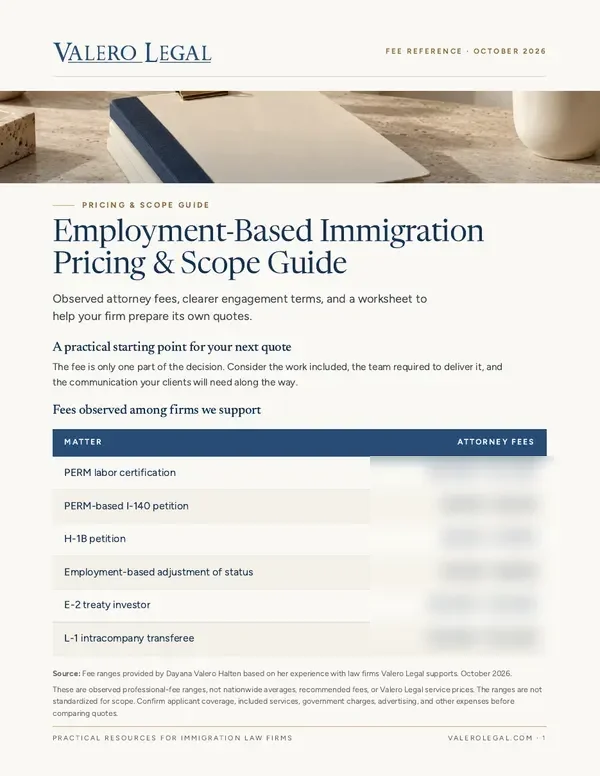
Employment-based immigration is overwhelmingly flat-fee work, and your pricing is ready when every flat fee is built from a real understanding of the hours inside it. A green card process for a sponsored employee typically spans several distinct matters — a PERM labor certification, an I-140 petition, and adjustment of status — each usually priced separately. As an illustration only: many firms treat each stage as its own four-figure flat fee, which means a single sponsored employee can represent a five-figure engagement spread over one to three years.
That structure is a gift if you price it well and a trap if you don’t. Questions to pressure-test:
- Do you know how many paralegal hours and attorney hours a standard PERM case actually consumes — or would you be guessing?
- Does your fee account for the non-standard events: audits, RFEs, recruitment restarts, job changes mid-process?
- Are payment milestones tied to case stages, so revenue arrives as work is performed rather than years later?
Firms that launch without this math tend to underprice to win early clients, then discover each case consumes more hours than the fee supports. The practice grows, and profit doesn’t. Set the pricing model before the first engagement letter goes out, not after the tenth.
Do you have systems that can track multi-year timelines?
Your case management has to hold deadlines that live months and years apart — and surface them without anyone remembering to look. Employment-based cases are long. Recruitment windows in PERM have specific validity periods. Priority dates may sit for years before a filing window opens. An H-1B employee’s status expiration has to be tracked alongside their green card progress.
A calendar and a spreadsheet can survive five active cases. They cannot survive fifty. Before launch, you want:
- A case management system with matter templates for each case type, so every case starts with its full task and deadline sequence built in.
- Automated deadline alerts with enough lead time to act — not a reminder the week something expires.
- Standard operating procedures for the recurring workflows, so quality doesn’t depend on which person touches the file.
- A simple set of KPIs — cases in progress by stage, average time per stage, revenue per case type — so you can see whether the practice is actually profitable.
This is the area firms most often skip, because it feels like overhead when case volume is low. It’s actually the cheapest moment to build it. Retrofitting systems onto thirty live cases is far more painful than launching with them on day one.
Do you have the right team — or a realistic plan to get one?
The economics of employment-based immigration depend on experienced paralegal support, so your team plan is as important as your marketing plan. In a well-run practice, paralegals handle the bulk of document preparation, recruitment tracking, and filing assembly, with attorney time concentrated on strategy and review. If every task runs through an attorney, the flat fees stop making sense.
You have three realistic staffing paths:
- Hire experienced business immigration paralegals. Fastest to competence, but they’re in demand, command strong salaries, and a full-time hire is a big commitment before you have volume.
- Train your existing team. Cheaper on paper, but slow — and someone experienced still has to supervise the learning curve.
- Use contract business immigration paralegal support. You get case-experienced production capacity that scales with your volume, without fixed payroll before the practice can support it. Many firms use this path to launch, then hire in-house once volume justifies it.
There’s no single right answer, but there is a wrong one: launching with no plan and assuming the casework will sort itself out.
What should you do if you’re not ready yet?
If you scored gaps in two or more areas, the answer isn’t to abandon the idea — it’s to sequence the build before you market the service. Most firms can get genuinely launch-ready in a few focused months: define the service line and pricing, set up matter templates and SOPs, arrange experienced paralegal capacity, and rebuild your client acquisition process for employer clients. Firms that do this work first take their opening cases profitably. Firms that skip it spend their first year subsidizing their own learning curve.
This is exactly the work Valero Legal does with law firms through Practice Development. We help you assess where you actually stand, build the systems and pricing, train your team — and because our contract paralegal team handles employment-based casework every day, we can support your first cases while your internal capacity grows. We don’t just hand you a plan; we help you run it.
If you’re weighing this move, the fastest way to get clarity is a conversation about your specific firm. Schedule a call and we’ll walk through your readiness honestly — including whether now is the right time.

Dayana Valero Halten has spent more than 20 years inside immigration practices, including Fragomen and Gunster — preparing PERM, I-140, H-1B and EB-1 matters and building the workflows behind well-run practices. She founded Valero Legal in 2015 to give immigration firms experienced paralegal capacity and hands-on practice development.
Meet Dayana